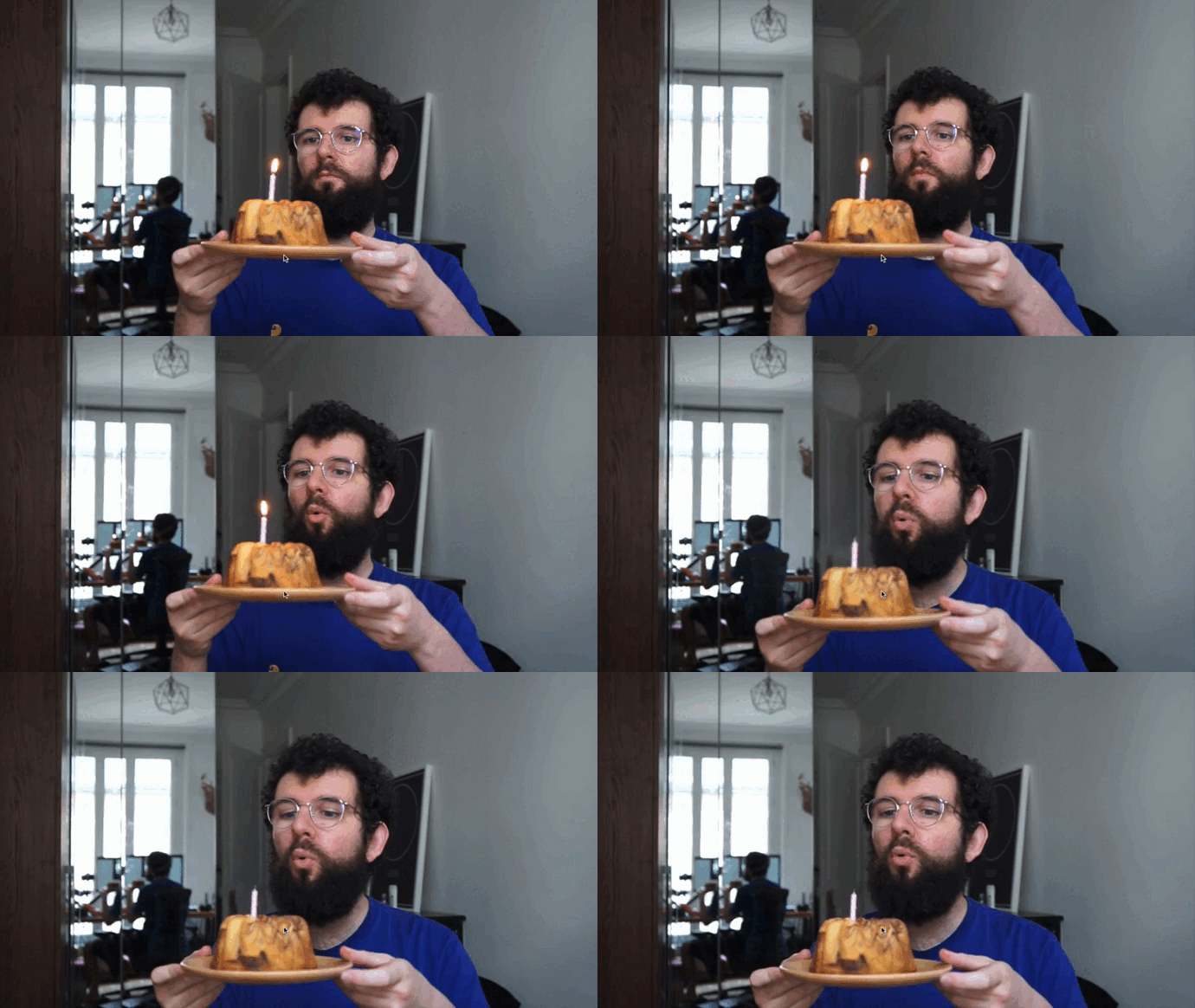
👋 Here is a special edition for me. Exactly 2 years ago, I sent out my first email newsletter. At the time, only 3 people received it. I already told the story in Robin's podcast, here is a written version. In 2021, I was doing Twitch lives twice a week, every Wednesday I was doing a data news round-up. One day, I decided to save the links on a blog created for the occasion, a few days later, 3 people subscribed. This is what made me decide to send emails containing my round-up. By chance.
So I want to thank Max, Théodore and Emiel, it is largely thanks to you that this newsletter exists. If you had not joined so early, I would never have realized that people would like to read my content. These bookmarks that I was saving mostly for myself.
Today, 104 editions later, I want to take a look back at my content creation journey, but also at my freelance journey that started one year earlier, in 2020.
The beginning
Before becoming a freelancer, I was working at Kapten, a French PHV company—an Uber competitor—where I was leading the data engineering team. We were a team of 6 people and our goal was to build the data platform for the company. During my time at Kapten, we built a data stack with Airflow, BigQuery and Metabase + Tableau. I was coming from the Hadoop world and BigQuery was a breath of fresh air. The component I'm most proud of is the ELT framework we built on top of Airflow to give total autonomy to analysts and scientists on the data loading and transformation processes.
In a nutshell it was an ETL-as-configuration on top of Airflow. You were able to define configs in Python to do full or incremental loading from different sources, processing in SQL or Python and exports. The framework and the processes were pretty strict, but it worked and gave full autonomy to analysts in building whatever they wanted to do. All the ownership was given back to others, we were just writing software and maintaining a platform.
I think it took almost a year to build the entire platform. We had set a goal: no broken Airflow pipelines in a 30-day sliding window. We achieved that. And we hit a plateau. We were doing less data engineering because everything was working well, less firefighting, looking for a new vision. As human beings, we wanted to fill the void, so we explored different things: real-time feature store, data lineage or data contracts—we call it this way today, but back in the days it was only schema management. But what was the next step for us?
I had done what I was hired to do: build a data platform for analytics and analysts. It was time for me to leave, at the same time the context changed: we got acquired and laid off. That's where my freelance journey started.
Going into freelance
I left the when the COVID was at a peak and a few people did not understand the move. To be honest I didn't even know where I was going but I was confident in my skillset and in my ability to sell my data engineering expertise. In retrospect I was just naive.
The Kapten experience brought me expertise on Airflow and GCP, a good knowledge about Kubernetes and a lead experience. In addition to my solid engineering and infra skills it creates a good resume.
By chance 2 of my former bosses heard about my freelancing and proposed me work. It led respectively to a 3-months and a 1-year mission with Equancy and Qonto. Then I did a mission with Yousign with Faouz that I met a few years earlier thanks to a LinkedIn message. The common point of the 3 missions was to build stuff around Airflow. In a blink my first company fiscal year was already done, with around €180k in revenue.
While I was at Qonto, we migrated to dbt, which was rapidly being adopted by French startups. This allowed me to add a new tool to my belt. Then it became a new expertise.
In my second fiscal year (2022), I had the privilege of working with the French tax authority to help them define the vision for the 2027 data platform and with the Ministry of Education to implement Superset and dashboards on that platform. In the blink of an eye, my second year was already over with less revenue (160k€) but in less time.
Along the way I also helped startups hiring—Folk, Modjo, Kard—and did mentoring—Blent.ai, Libeo, iBanFirst, nibble. I even hired 2 awesome interns who helped me on the blog for a few months. As 2023 is still running I'll keep it for another retrospective.
While my story is exciting, here are a few things to learn from it:
- Former co-workers are part of your network and are probably the ones who vouch for you the most.
- In terms of networking, participate in events, give to the community and you will receive something at some point. Don't be afraid to solicit people on LinkedIn, people respond more often than you'd think.
- Find the main reason why you want to freelance. It can be many things like money, freedom, issues with authority, digital nomadism, etc.
- If it's money I think you gonna miss the freedom part of being freelance. If you want to do a lot of ca$h you will work every day, in a long-term mission for a big company. Which is actually like a permanent position without the perks of it (at least in countries where we have a social system).
- Set your daily rate and (try to) stick to it. I started at €800, then went up to €1000 and now I'm at €1200. Don't forget that you are competing with agencies, often charging high prices.
- One of my strict conditions is to work only part-time. In fact, I work an average of 2.5 days a week. To be successful, you have to be organized and be aware of context switching. To be honest, this is very difficult and I am bad at it.
- In my opinion, to freelance in data engineering, you need at least two or three proven experiences in data engineering. Very often, as a freelancer, you are perceived as someone who knows things. To be assertive, you'll need to be confident in your recommendations.
- Identify your strengths and communicate clearly about it. Here how I say it: I'm a data engineer who built a lot of data platform for analytics, I have an expertise in Airflow, dbt, Superset and in infrastructure.
Juggling with content creation
Doing freelance data engineering is a great thing for me, I've been working with computers since I was young. It's always better when passion meets your work. Alongside this, I also started creating content in January 2021. This was one of my goals when I decided to go part-time so I could have time for content creation.
I did not set clear business objectives over my content creation. Finally I did an engineering school, not a business school. It's probably the reason why I often loose focus and do multiple things. Here is a small selection of what I tried:
- Twitch — I've done 4 months of Twitch at the beginning, but my 2-months holidays with no internet broke my routine. I don't think I'll go back to solo lives.
- I made YouTube videos — I have 7 videos, each video took me about 20 hours, hard to add it into my daily routine but it will come back.
- Twitter — even if went from 200 followers to 400 followers to Twitter I can't find my voice there. This is sad because Twitter is the social network I consume the most.
- LinkedIn — I tried multiple things on LinkedIn but I don't have the discipline to publish one post a day. In the end I went from 2000 followers to 6000+ in 2 years.
- Podcasts — the new thing I've recently started. Once again I loose focus, but, the podcast format is so statisfying to do.
And finally, the newsletter, which is my safe place. I've found discipline in writing my own content with my own tone. It takes me about a day of work per week. Basically, I spend 2 hours selecting content, 1 hour reading the content, 2 hours writing, and 1 hour post-processing. In the end, I'm proud of the quality of the newsletter, but one day is a lot and after 3 years, I have to wonder which direction to go in.
Actually, I don't care I'll continue like this. But why do I do content:
- I like to share / transmit to others, when I was a kid I wanted to be a maths teacher.
- It creates visibility for me and as a freelance I need to be visible.
- It helps me shape my ideas.
- I love the adrenaline rush I get when I do things publicly. Even though there are serious downsides to it, like FOMO or addiction, I love it.
- I hope that in the long run it will generate enough money for me to do less consulting. Blog subscriptions bring me 300 € / month. Which is less than 2% of my revenue 🫠.
Conclusion
This is a post that is more personnal than what I usually do. This time I did not promise anything like I already did in the past. Promises I didn't keep because I'm lazy. At least I learn from my mistakes.
Whether you are a customer, a friend or a subscriber thank you very much for your support over the past 3 years. Let's continue for another 3 years? ❤️